
Oracle Performance Tuning Guide |Why Oracle Databases Become Slow Over Time
Over the past two decades working with enterprise Oracle systems, I’ve seen how Oracle database performance gradually declines when environments grow faster than their optimization strategies.
For the first few months after deployment, most Oracle databases perform beautifully.
Applications feel responsive. Reports finish quickly. Users are happy. Management assumes the infrastructure is “future ready.”
Then slowly… things begin to change.
A report that once completed in 30 seconds starts taking 5 minutes.
Batch jobs begin overlapping.
CPU utilization rises during business hours.
Developers complain that “the database is slow.”
And eventually, someone suggests:
“We probably need bigger servers.”
After working with Oracle databases for more than three decades across banking, telecom, healthcare, manufacturing, ERP systems, eCommerce platforms, and enterprise production environments — I can say this confidently:
Most Oracle performance problems are not caused by Oracle itself.
They are usually the result of gradual system evolution that nobody actively managed.
Oracle databases rarely become slow overnight.
They become slow over time.
And understanding why that happens is the first step toward building a stable, scalable enterprise database environment.
Proper Oracle performance tuning is not a one-time task performed during deployment. It is an ongoing operational discipline.
The Biggest Myth About Oracle Performance Tuning
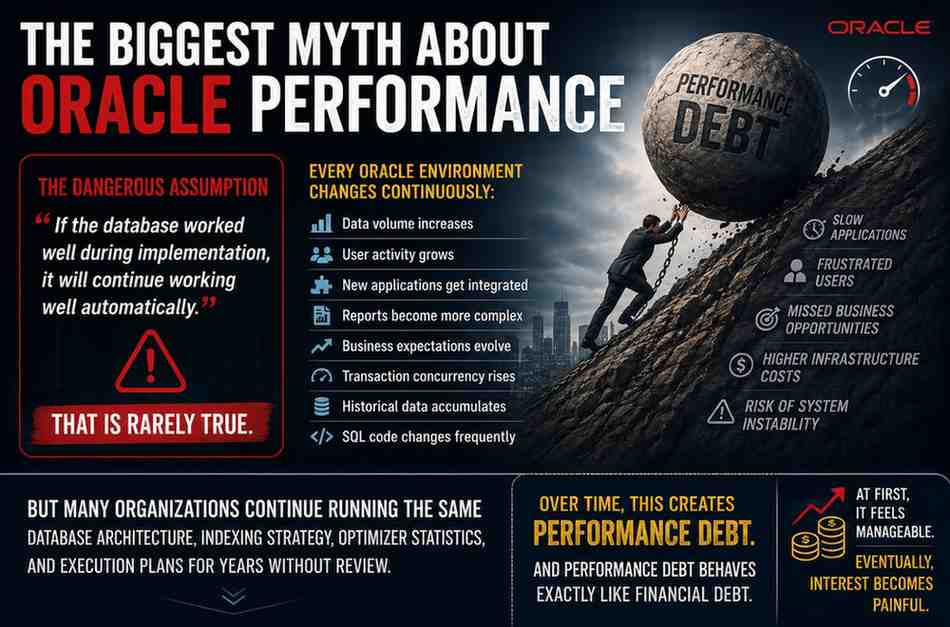
One of the most dangerous assumptions in enterprise IT is:
“If the database worked well during implementation, it will continue working well automatically. no Oracle Performance Tuning is required ”
That is rarely true.
Every Oracle environment changes continuously:
- Data volume increases
- User activity grows
- New applications get integrated
- Reports become more complex
- Business expectations evolve
- Transaction concurrency rises
- Historical data accumulates
- SQL code changes frequently
But many organizations continue running the same database architecture, indexing strategy, optimizer statistics, and execution plans for years without review.
Over time, this creates performance debt.
And performance debt behaves exactly like financial debt.
At first, it feels manageable.
Eventually, interest becomes painful.
Why Oracle Database Performance Degrades Over Time - Most production slowdowns happen in phases.
Phase 1 – Small Delays Begin
Initially, users notice only occasional slowness:
- Some reports take longer
- Screens intermittently freeze
- Batch jobs exceed expected windows
- CPU spikes appear during peak load
At this stage, organizations often ignore the symptoms because systems are still operational.
Lorem ipsum dolor sit amet, consectetur adipiscing elit. Ut elit tellus, luctus nec ullamcorper mattis, pulvinar dapibus leo.
Phase 2 – Resource Pressure Increases
As workloads grow:
- Memory pressure rises
- Disk I/O increases
- Wait events accumulate
- SQL execution becomes inconsistent
- Blocking sessions increase
Now performance issues become visible to business teams.
Phase 3 – Production Stability Is Impacted
Eventually the database reaches a tipping point.
Now organizations experience:
- Critical application slowdowns
- Transaction bottlenecks
- Timeouts
- Failed batch processing
- User complaints
- Revenue impact
- SLA violations
This is typically when companies finally call Oracle performance specialists.
Unfortunately, by this point, Oracle Performance Tuning becomes more difficult because the environment already carries years of accumulated inefficiencies.
Workload Growth Changes Everything
One of the most common causes of Oracle slowdown is simple workload growth.
A database designed for:
- 500 users
- 50 GB of data
- 20 TPS (transactions per second)
may now be handling:
- 5,000 users
- multiple terabytes
- real-time analytics
- API traffic
- mobile integrations
- continuous reporting
But many organizations still run the same architecture designed years earlier.
The database was never redesigned for current workloads.
Oracle is extremely powerful, but even the best database engine cannot compensate indefinitely for uncontrolled growth without optimization.
Poor Indexing Slowly Destroys Oracle Performance Tuning
I have seen enterprise systems where:
- indexes were missing entirely
- duplicate indexes existed
- unused indexes consumed resources
- indexes became fragmented
- composite indexes were designed incorrectly
Indexing problems usually develop gradually because applications evolve faster than database structures.
Developers add new queries.
Reports become more complicated.
Filters change.
Search conditions expand.
But indexing strategies are rarely reviewed proactively.
Over time, Oracle begins scanning significantly larger portions of tables.
That creates:
- excessive logical reads
- physical I/O growth
- higher CPU utilization
- slower response times
And once large table scans become common in production systems, overall database performance deteriorates rapidly.
Inefficient Execution Plans Are Silent Killers
In my experience, execution plan instability is one of the most underestimated Oracle performance tunning problems.
A SQL query that performed efficiently last year may suddenly become extremely slow today.
Why?
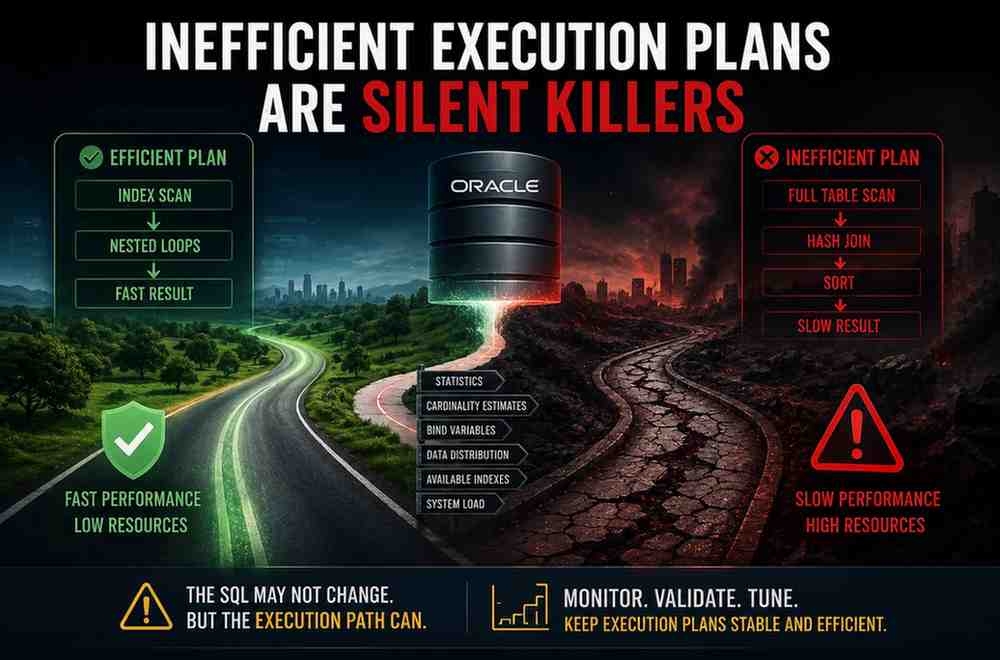
Because Oracle’s optimizer continuously makes decisions based on:
- statistics
- cardinality estimates
- bind variables
- data distribution
- available indexes
- system load
As data patterns evolve, Oracle may choose completely different execution plans.
Sometimes dramatically worse ones.
This is where many organizations struggle.
The SQL statement itself may not have changed.
But the execution path has changed.
That distinction is critical.
I’ve worked on production incidents where:
- a query suddenly shifted from index access to full table scans
- nested loops became hash joins
- optimizer estimates became inaccurate
- stale statistics caused catastrophic execution choices
And the result was immediate production slowdown.
Not because Oracle failed.
Because the environment evolved beyond its original optimization assumptions.
Effective Oracle performance tuning requires continuous execution plan analysis because optimizer decisions evolve as data grows.
Stale Statistics Create Dangerous Optimizer Decisions
Oracle’s optimizer depends heavily on statistics.
When statistics become outdated:
- row count estimates become inaccurate
- execution plans degrade
- join strategies fail
- index selection becomes inefficient
Many organizations underestimate how quickly data distribution changes in large systems.
A table that once contained 1 million rows may now contain 500 million rows.
But if optimizer statistics do not accurately reflect reality, Oracle may generate highly inefficient plans.
This is especially dangerous in environments with:
- rapidly growing transactional data
- skewed data distribution
- partitioned tables
- mixed OLTP and reporting workloads
Regular statistics management is one of the simplest yet most overlooked aspects of Oracle performance tuning.
Bad SQL Eventually Overwhelms Good Hardware
This is a lesson many businesses learn the expensive way.
Hardware upgrades cannot permanently solve inefficient SQL.
You can add:
- more CPUs
- faster storage
- additional memory
- high-end infrastructure
But poorly optimized SQL eventually consumes those resources too.
I once worked with a company that upgraded storage infrastructure twice within three years because reporting systems kept slowing down.
After detailed analysis, the real issue was:
- inefficient joins
- repeated full table scans
- redundant sorting operations
- missing predicates
- poor indexing
Once SQL optimization was completed, resource utilization dropped dramatically.
The database suddenly appeared “faster,” even though hardware remained unchanged.
The issue was never infrastructure.
It was execution efficiency.
Fragmented Growth Creates Architectural Problems
Over decades, many Oracle environments become operationally fragmented.
Different teams implement changes independently.
New modules get added.
Legacy systems remain connected.
Temporary fixes become permanent architecture.
Eventually the database environment resembles a city built without urban planning.
At that point, performance issues become structural rather than isolated.
You begin seeing:
- dependency chains
- locking contention
- concurrency bottlenecks
- RAC interconnect pressure
- inefficient storage allocation
- excessive redo generation
- archive log growth
- unstable workloads
This is why mature Oracle environments require periodic architectural reviews — not just reactive troubleshooting. Oracle Performance Tuning Is a Continuous Process
Oracle Performance Tuning Is a Continuous Process
Oracle Performance Tuning Is a Continuous Process as Oracle databases are never static environments. As businesses grow, workloads increase, SQL queries become more complex, applications evolve, and transaction volumes rise continuously. A database that performed efficiently during implementation may gradually slow down over time if optimization strategies are not reviewed regularly. This is why Oracle Performance Tuning should never be treated as a one-time activity.
In enterprise environments, workload evolution changes the behavior of the entire database ecosystem. More users, larger datasets, reporting requirements, API integrations, and concurrent transactions place increasing pressure on CPU, memory, storage, and network resources. Over time, these changes begin affecting application response times and overall database stability.
SQL behavior also changes continuously. Developers modify queries, introduce new joins, create additional reports, and expand application functionality. Even small SQL changes can significantly impact execution costs in large Oracle databases. Without regular analysis, inefficient SQL statements slowly consume more resources and create performance bottlenecks.
Oracle optimizer behavior evolves as data distribution changes. Queries that once used efficient indexes may suddenly shift toward expensive full table scans or inefficient join operations. This makes execution plan analysis an essential part of Oracle Performance Tuning for long-term database health.
Indexing strategies must also adapt to changing business requirements. New search conditions, reporting patterns, and workload distribution often require index redesign and optimization. Organizations that proactively invest in Oracle Performance Tuning typically maintain better scalability, improved application performance, and more stable production environments over time.
Oracle RAC Does Not Automatically Solve Performance Problems
Many enterprises assume Oracle RAC guarantees scalability automatically.
It does not.
Oracle RAC introduces its own complexity:
- global cache management
- interconnect traffic
- block contention
- workload balancing challenges
- cluster synchronization overhead
If SQL inefficiencies exist in a RAC environment, they often become amplified across nodes.
I’ve seen RAC clusters with enormous hardware capacity still suffer from poor application response times because the real issue was inefficient workload design.
Scaling inefficient SQL simply spreads inefficiency faster.
Monitoring Alone Is Not Optimization
Modern monitoring tools are excellent at detecting problems.
But detecting problems and solving them are very different things.
Monitoring may show:
- top wait events
- high CPU sessions
- expensive SQL
- locking chains
- I/O spikes
But interpreting why those issues occur requires deep Oracle experience.
That experience matters most during production incidents where every minute impacts business operations.
Tools provide visibility.
Experience provides direction.
Why Preventive Oracle Performance Tuning Matters
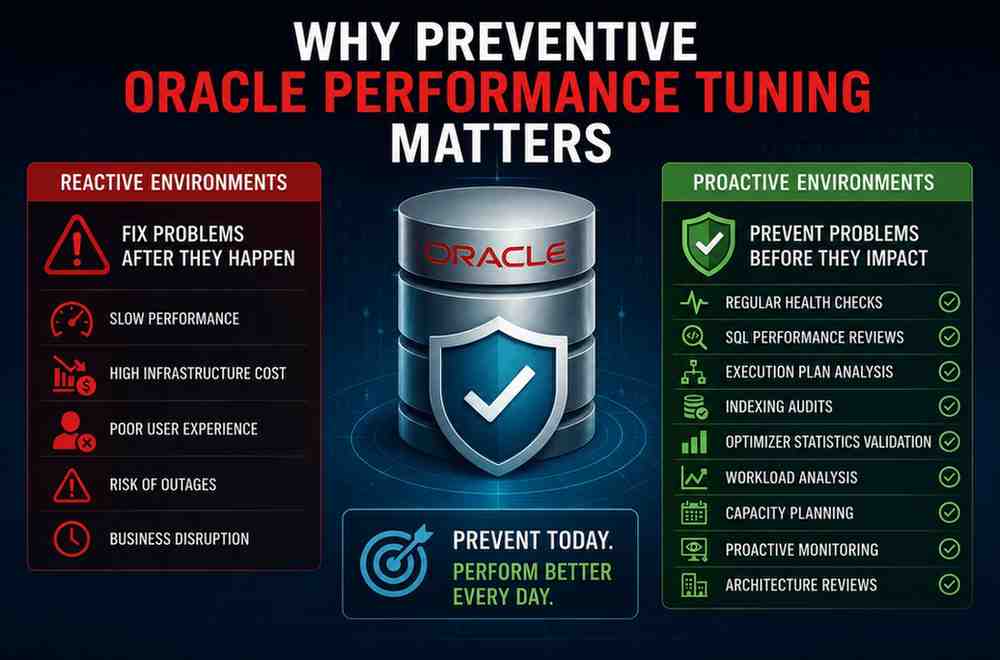
The healthiest Oracle environments are proactive.
Not reactive.
Organizations that consistently maintain stable performance usually invest in:
- regular database health checks
- SQL performance reviews
- execution plan analysis
- indexing audits
- optimizer statistics validation
- workload analysis
- capacity planning
- proactive monitoring
- architecture reviews
These activities prevent small inefficiencies from becoming enterprise-wide performance crises.
The Real Business Cost of Slow Oracle Databases
Database slowdown is never only a technical issue.
It impacts:
- customer experience
- operational productivity
- employee efficiency
- revenue generation
- reporting accuracy
- SLA compliance
- business scalability
When applications slow down, entire business workflows slow down.
And in modern enterprises, database performance directly affects business reputation.
That is why Oracle performance tuning should never be treated as optional maintenance.
It is business infrastructure management.
Final Thoughts
After 22+ years working with Oracle databases, one pattern remains consistent:
Oracle databases become slow over time because businesses evolve faster than database optimization strategies.
The slowdown is usually gradual.
Silent.
Accumulated.
And often ignored until production systems become unstable.
But the good news is this:
Most Oracle performance issues are solvable when identified early.
With proper tuning, indexing strategy, execution plan analysis, workload management, and architectural optimization, Oracle databases can continue performing efficiently even under massive enterprise workloads.
The key is proactive performance management before problems become critical.
If your Oracle environment is already showing signs of slowdown, instability, or scaling pressure, it may be time for a deeper performance assessment before small inefficiencies become major production risks.
Long-term Oracle database performance depends on proactive monitoring, SQL optimization indexing strategy, and regular health assessments.
Businesses that invest consistently in Oracle performance tuning usually experience better scalability, application stability and operational efficiency.