
PostgreSQL vs Oracle for Mission-Critical Fintech: A Brutally Honest 2026 Comparison
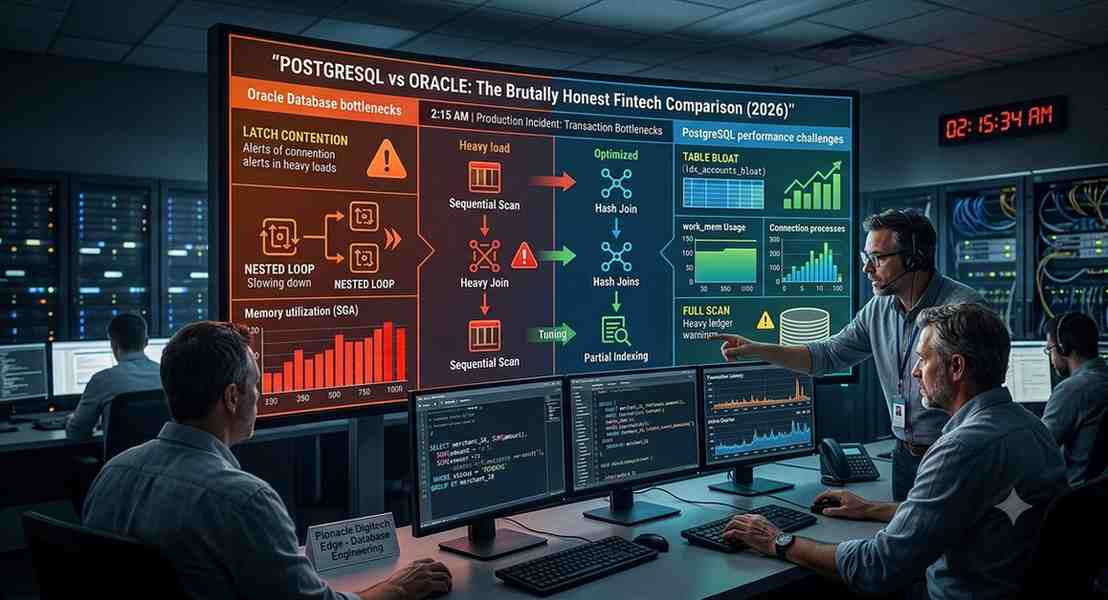
It was 2:15 AM on a frantic Tuesday when the pager went off. A fast-growing digital lending platform was processing mid-month payout batches. Transactions were piling up in the queue, API gateways were timing out, and customer service channels were lighting up with frustrated users.
On paper, everything looked fine. The database instance had plenty of provisioned IOPS, RAM usage sat at a comfortable 45%, and CPU utilization was hovering around 60%. Yet, under the hood, a single crucial database table was experiencing severe lock contention. A routine fraud-check query was forcing full sequential scans on millions of unindexed payment records, starving concurrent transaction writes.
In high-stakes financial technology, these scenarios are all too familiar. Whether you are running payment gateways, core banking engines, or high-frequency trading ledgers, database bottlenecks directly impact revenue and brand trust.
When architects build mission-critical financial software, the conversation inevitably lands on a high-stakes choice: stick with the proven enterprise giant, Oracle, or migrate to the rapidly evolving open-source powerhouse, PostgreSQL?
Here is an unfiltered technical comparison of how both relational database engines perform under real-world financial workloads, alongside the exact execution plan fixes required when production systems slow down.
The Architectural Reality: Engine Mechanics in Financial Systems
Financial transactions demand uncompromising ACID compliance, microscopic latencies, and zero data loss. Both PostgreSQL and Oracle handle these demands, but their underlying architectures approach concurrency and storage in fundamental ways that directly impact your application logic.
Concurrency and Transaction Isolation
Oracle relies on its Multi-Version Concurrency Control (MVCC) implementation backed by dedicated Undo Tablespaces. When a transaction modifies a row, Oracle writes the old image of that row to the Undo segment. This design guarantees that readers never block writers and writers never block readers. It also keeps table storage cleanly packed without requiring background cleanup processes for read-consistency.
PostgreSQL handles MVCC by writing new row versions directly into the main data pages, flagging older versions with transaction metadata (xmin and xmax). While this architecture makes point-in-time rollback operations extremely lightweight, it introduces table bloat. To manage dead tuple cleanup, PostgreSQL relies heavily on its autovacuum process. In heavy fintech workloads with millions of rapid UPDATE operations per minute—such as updating wallet balances or transaction status fields—an under-tuned autovacuum worker can cause severe page bloat, leading to unexpected sequential scans and degraded cache efficiency.
Memory Architecture and Connection Handling
Oracle utilizes a shared memory architecture (the System Global Area, or SGA) paired with process-based or thread-based execution models. It manages thousands of concurrent client connections efficiently through native Shared Servers or Connection Manager (CMAN).
PostgreSQL operates on a process-per-connection model. Every new client connection spawns a distinct backend OS process, consuming roughly 2MB to 10MB of RAM per connection just in overhead. In a microservices fintech architecture where hundreds of API instances spin up to handle peak transaction spikes, routing connections directly to PostgreSQL will rapidly exhaust system memory and trigger CPU context switching. Implementing a dedicated layer like PgBouncer for transaction-level connection pooling is non-negotiable for enterprise PostgreSQL deployments.
Real-World Query Tuning: Resolving Execution Bottlenecks
Even on top-tier infrastructure, bad query plans will degrade your application performance. Let’s examine two common execution bottlenecks that plague fintech platforms and how to fix them in both engines.
1. Eliminating Devastating Sequential Scans on Heavy Tables
Consider a financial ledger table storing 50 million historical transaction records. A microservice queries the system to calculate daily merchant settlements:
SQL
SELECT merchant_id, SUM(amount)
FROM transaction_ledger
WHERE status = 'PENDING'
  AND created_at >= NOW() - INTERVAL '24 hours'
GROUP BY merchant_id;
The Problem
If the database engine chooses a Sequential Scan (PostgreSQL) or a FULL TABLE SCAN (Oracle), it reads every single block of the 50GB table from disk or buffer cache to evaluate the conditions. As the table grows, query execution times degrade from milliseconds to several minutes.
The Root Cause
The engine resorts to a full scan because either:
No composite index covers both
statusandcreated_at.Existing table statistics are stale, causing the query planner to miscalculate row selectivity.
An unindexed foreign key or type mismatch forces an implicit conversion function on the column.
The Production Fix
In PostgreSQL, a standard B-tree index on (status, created_at) might still prove inefficient if PENDING represents only 1% of the table while COMPLETED represents 99%. Instead, deploy a Partial Index:
SQL
CREATE INDEX idx_pending_transactions
ON transaction_ledger (created_at, merchant_id, amount)
WHERE status = 'PENDING';
This partial index reduces index size by up to 90%, keeps working datasets inside shared_buffers, and enables an Index Only Scan, avoiding main table block reads entirely.
In Oracle, ensure table statistics are refreshed via DBMS_STATS.GATHER_TABLE_STATS and implement a composite index with index skip scanning enabled, or leverage partitioned tables on created_at with local indexes.
SQL
EXEC DBMS_STATS.GATHER_TABLE_STATS(
    ownname => 'FINTECH',
    tabname => 'TRANSACTION_LEDGER',
    estimate_percent => DBMS_STATS.AUTO_SAMPLE_SIZE
);
2. Resolving Nested Loop Bottlenecks During Heavy Joins
When reconciling account balances against user profiles, a query might join the users table with the accounts table:
SQL
SELECT u.user_id, u.risk_score, a.account_number, a.balance
FROM users u
JOIN accounts a ON u.user_id = a.user_id
WHERE u.risk_score > 80;
The Problem
The query planner selects a Nested Loop Join. While Nested Loops are exceptionally fast for small datasets (retrieving 1 to 10 rows), they become catastrophic when the outer table returns 100,000 high-risk users. The database executes 100,000 individual index lookups against the accounts table, leading to massive random disk I/O and CPU spikes.
-- Unoptimized PostgreSQL Execution Plan Output
Nested Loop  (cost=0.42..85420.10 rows=102140 width=48)
  ->  Seq Scan on users u  (cost=0.00..12410.00 rows=102140 width=16)
        Filter: (risk_score > 80)
  ->  Index Scan using idx_accounts_user_id on accounts a  (cost=0.42..0.70 rows=1 width=32)
        Index Cond: (user_id = u.user_id)
The Production Fix
To resolve this, force the optimizer to switch from a Nested Loop to a Hash Join, which builds an in-memory hash table of the smaller dataset and scans the larger dataset just once.
In PostgreSQL, if the planner incorrectly chooses a Nested Loop, it is usually because the work_mem parameter is set too low (defaulting to 4MB), making the planner think a Hash Join won’t fit in memory:
SQL
-- Increase memory allocation for the session/transaction to allow Hash Joins
SET work_mem = '64MB';
In Oracle, missing histogram statistics often cause the optimizer to underestimate row counts, defaulting to nested loops. Gathering histograms onskewed columns like risk_score gives the Oracle Cost-Based Optimizer (CBO) the accurate data required to choose a Hash Join automatically:
SQL
EXEC DBMS_STATS.GATHER_TABLE_STATS(
    ownname => 'FINTECH',
    tabname => 'USERS',
    method_opt => 'FOR COLUMNS SIZE 254 risk_score'
);
Licensing, Cloud Portability, and Long-Term ROI
Beyond query execution plans, long-term architectural success hinges on total cost of ownership (TCO) and operational freedom.
| Feature / Dimension | PostgreSQL | Oracle Database |
| Licensing Model | Open-source (PostgreSQL License) | Proprietary (Per-Core Licensing + Options) |
| Cloud Portability | Native across AWS (RDS/Aurora), GCP, Azure, On-Prem | Oracle Cloud Infrastructure (OCI) or complex cloud licensing |
| High Availability | Patroni, Streaming Replication, pg_auto_failover | Oracle Real Application Clusters (RAC), Data Guard |
| Extensibility | Rich extension ecosystem (PostGIS, pg_stat_statements, timescaledb) | Native feature suites (In-Memory, Spatial, Partitioning) |
| Operational Overhead | Requires active tuning (autovacuum, connection pooling) | Requires dedicated enterprise DBA administration |
While Oracle remains an exceptionally powerful database engine with unmatched RAC clustering abilities, its steep licensing costs and complex core-matching rules push modern engineering teams toward PostgreSQL. With proper memory tuning, partitioning strategies, and connection pooling, PostgreSQL reliably processes tens of thousands of financial transactions per second at a fraction of the infrastructure cost.
Stabilize Your High-Transaction Database Infrastructure
Whether you are scaling a fast-growing financial application on PostgreSQL or optimizing an enterprise Oracle platform, poor execution plans, lock contention, and connection bottlenecks can jeopardize business continuity.
Our team of principal technology consultants brings over two decades of hands-on database architecture and production tuning experience to high-volume systems. Learn how our enterprise database specialists at Pinnacle Digitech Edge help organizations eliminate query latency, modernize legacy infrastructure, and maintain 24/7 high availability.