
Need Help Investigating a Slow Oracle Database?
Whether you're dealing with execution plan instability, long-running SQL statements, Oracle RAC bottlenecks, AWR findings, or unexplained application slowdowns, our Oracle specialists help identify root causes quickly and recommend practical solutions that reduce risk and restore performance.

Oracle Consulting Services in Noida | Oracle Performance Investigation
When Oracle Performance Problems Start Quietly
Most Oracle database incidents don’t begin with alarms.
They don’t start with a server crash.
They rarely begin with a database outage.
Instead, they start quietly.
- A monthly report takes a little longer than usual.
- An application screen begins loading slower during peak hours.
- A finance batch that once completed before sunrise starts spilling into business hours.
- Support tickets appear occasionally.
- Users notice delays but continue working around them.
For weeks, everything seems manageable.
Then one day, performance drops enough that business operations are affected.
At that point, teams often focus on symptoms.
- Additional CPU is allocated.
- Memory settings are adjusted.
- Storage metrics are reviewed.
- Application servers are restarted.
- Yet the problem remains.
The reality is that Oracle performance issues often originate deep within SQL execution paths, workload patterns, indexing strategies, and execution plan decisions.
At Pinnacle Digitech Edge, we help organizations across Noida investigate, diagnose, and resolve Oracle database challenges before they become business disruptions.
Our Oracle Consulting Services in Noida are designed for enterprises that require practical solutions to complex database problems, not generic recommendations copied from documentation.
Why Oracle Databases Become Slow Over Time
One of the biggest misconceptions in database management is that performance issues appear suddenly.
In most cases, Oracle environments gradually drift toward inefficiency.
- Data volumes grow.
- Business processes expand.
- Applications introduce new queries.
- Indexes that once worked well become less effective.
- Statistics become outdated.
- Execution plans begin changing.
- What performed efficiently six months ago may no longer be the best path for Oracle’s optimizer today.
This is why many organizations experience unpredictable performance behavior.
- The database itself is healthy.
- Infrastructure appears stable.
- Yet users continue reporting delays.
The issue often lies in how Oracle chooses to execute workloads rather than the workload itself.
Understanding these patterns requires more than monitoring dashboards.
It requires deep investigation into execution plans, wait events, workload distribution, and query behavior.
That is where specialized Oracle consulting becomes valuable.
The Production Incident Nobody Saw Coming
A manufacturing company in the Noida region recently faced an issue that looked like a storage bottleneck.
- Application response times increased dramatically every afternoon.
- The infrastructure team reviewed storage metrics.
- The network team checked latency.
- The application team inspected middleware logs.
- Nothing appeared abnormal.
When we reviewed the Oracle environment, a different story emerged.
A critical query that had been running efficiently for months was suddenly using a completely different execution plan.
The optimizer had switched strategies after data distribution changed significantly.
The result was a dramatic increase in logical reads and processing time.
- No hardware upgrade was required.
- No architectural redesign was necessary.
The issue was resolved by understanding why Oracle changed its execution approach and correcting the underlying factors influencing optimizer decisions.
Situations like this are common.
- Oracle databases rarely become slow without a reason.
- The challenge is identifying the real reason quickly.
Understanding Execution Plans Before Problems Escalate
An execution plan is effectively Oracle’s roadmap for retrieving data.
Every SQL statement receives an execution strategy.
Oracle decides which indexes to use.
It determines join methods.
It evaluates access paths.
It calculates estimated costs.
When the chosen path aligns with actual data characteristics, performance remains stable.
When assumptions differ from reality, performance can deteriorate rapidly.
This explains why two identical queries can behave completely differently in production.
The SQL statement hasn’t changed.
The application hasn’t changed.
Yet execution time increases dramatically.
The answer often lies within the execution plan itself.
Our Oracle Consulting Services in Noida focus heavily on execution plan investigation because understanding how Oracle executes a query is often the fastest route to identifying performance bottlenecks.
How Nested Loop Joins Create Hidden Performance Bottlenecks
Nested loop joins are not inherently bad.
In fact, they can be extremely efficient when Oracle accesses small result sets through highly selective indexes.
Problems emerge when assumptions change.
A query expected to return hundreds of rows suddenly processes hundreds of thousands.
The nested loop continues executing exactly as designed.
However, the number of repeated lookups increases dramatically.
What once required milliseconds may suddenly require minutes.
From an application perspective, the slowdown appears mysterious.
From Oracle’s perspective, it is simply following the execution strategy it selected.
Understanding when nested loops are appropriate and when alternative join methods should be considered is a critical aspect of Oracle SQL performance consulting.
Ignoring these patterns often leads to recurring production incidents that become increasingly difficult to diagnose.
The Hidden Cost of Missing and Ineffective Indexes
Many Oracle performance issues can be traced back to indexing decisions.
Some environments suffer from too few indexes.
Others suffer from too many.
Both situations create challenges.
Without proper indexing, Oracle may evaluate large portions of a table before locating required records.
As datasets grow, the impact becomes increasingly visible.
Queries that once completed quickly begin consuming additional resources.
Users experience delays.
Applications become less responsive.
Creating indexes indiscriminately is not the answer.
Every index introduces maintenance overhead.
The goal is strategic indexing aligned with workload patterns and business requirements.
This balance requires careful analysis rather than guesswork.
Organizations that approach indexing strategically typically experience greater stability, improved scalability, and more predictable query performance.
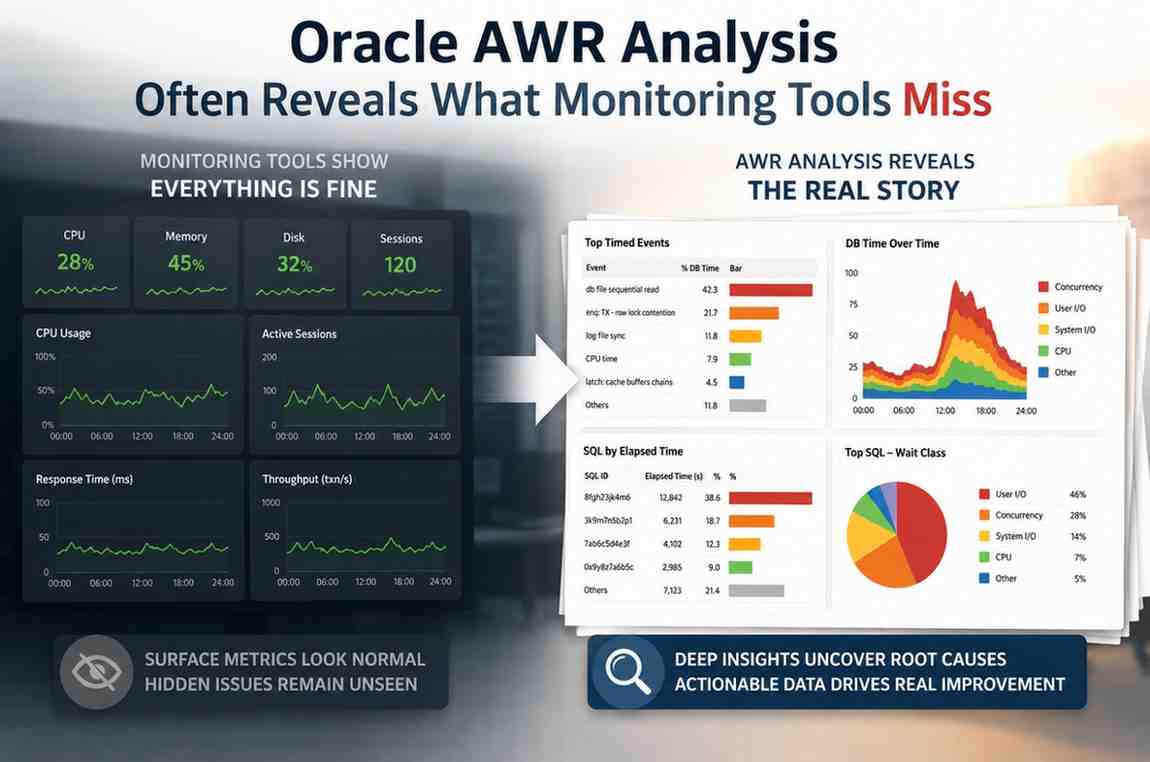
Oracle AWR Analysis Often Reveals What Monitoring Tools Miss
Many organizations invest heavily in monitoring platforms.
- Dashboards display CPU utilization.
- Memory consumption appears normal.
- Storage latency remains within expected thresholds.
- Everything looks healthy.
Yet users continue reporting slow response times.
This is where Oracle AWR analysis becomes invaluable.
An AWR report provides a historical view of database activity, allowing engineers to understand what was actually happening during periods of poor performance.
Instead of guessing, teams can examine workload patterns, top SQL statements, wait events, I/O behavior, concurrency issues, and resource consumption trends.
Over the years, we have seen countless situations where infrastructure appeared healthy while Oracle workloads were struggling underneath.
The problem was never the hardware.
The challenge was understanding how database activity evolved over time and identifying the specific workloads responsible for degradation.
AWR analysis transforms performance troubleshooting from speculation into evidence-based decision-making.
Why Wait Events Matter More Than Resource Utilization
One of the most common mistakes in Oracle troubleshooting is focusing exclusively on resource usage.
- High CPU utilization attracts attention.
- Memory consumption generates concern.
- Storage activity appears alarming.
- However, Oracle databases frequently reveal their real problems through wait events.
A database session may spend most of its time waiting rather than consuming resources.
- The application experiences delays.
- Users perceive slowness.
Yet infrastructure metrics remain relatively stable.
Understanding wait events allows organizations to identify where Oracle sessions spend their time and why.
- Sometimes the issue involves inefficient SQL execution.
- Sometimes it involves locking contention.
In other cases, concurrency bottlenecks prevent workloads from progressing efficiently.
The ability to interpret wait event patterns often separates effective troubleshooting from endless trial-and-error adjustments.
Using ASH Analysis to Understand Active Workloads
When performance incidents occur, teams frequently ask the same question.
What exactly was the database doing when users reported the problem?
Oracle ASH provides answers.
Active Session History captures detailed information about database activity during execution.
It allows engineers to reconstruct events and understand workload behavior at a much deeper level.
Instead of reviewing isolated snapshots, ASH helps identify trends.
- Which sessions were active?
- Which SQL statements consumed the most resources?
- What waits dominated the workload?
- Which users or applications generated the highest activity?
- These insights are often critical when diagnosing intermittent issues that are difficult to reproduce.
In many environments, ASH analysis reveals workload patterns that would otherwise remain invisible.
Oracle RAC Performance Challenges Require Specialized Investigation
Oracle RAC environments provide scalability and availability benefits, but they also introduce complexity.
Performance issues in RAC systems often behave differently than issues in standalone databases.
- A query may perform well on one node and poorly on another.
- Interconnect traffic may increase unexpectedly.
- Global cache waits may begin affecting response times.
- Workloads may become unevenly distributed across nodes.
Because multiple instances operate together, root cause analysis requires a broader perspective.
Investigating RAC performance means understanding how workloads interact across the cluster and identifying where communication overhead, contention, or workload imbalance creates bottlenecks.
Organizations relying on Oracle RAC often discover that solving performance issues requires more than traditional database administration.
It requires experience interpreting RAC-specific behaviors and understanding how cluster activity influences overall application performance.
Why Oracle Workload Patterns Change Over Time
A database that performs well today may not perform the same way six months from now.
Business growth changes workloads.
- New applications introduce additional demand.
- Historical data accumulates.
- Reporting requirements expand.
- Customer activity increases.
- The environment evolves.
Unfortunately, many Oracle environments continue operating under assumptions established years earlier.
- Indexes remain unchanged.
- Execution strategies remain unreviewed.
- Capacity forecasts become outdated.
Eventually, workload growth exceeds the assumptions upon which earlier optimizations were based.
The result is gradual performance degradation.
Organizations often assume a major event triggered the slowdown.
In reality, the database simply evolved beyond its original design assumptions.
Regular workload analysis helps identify these shifts before they become production incidents.
Oracle Database Health Assessments Prevent Expensive Surprises
The most effective performance investigations often occur before users notice problems.
A proactive Oracle Database Health Assessment examines the overall condition of the environment and identifies areas that deserve attention.
- Workload distribution is reviewed.
- Execution patterns are analyzed.
- Index effectiveness is evaluated.
- Configuration settings are assessed.
- Growth trends are examined.
- Resource utilization is studied.
- The goal is not simply identifying existing issues.
The objective is understanding future risk.
Organizations that perform periodic assessments are significantly more likely to prevent outages, avoid emergency troubleshooting, and maintain stable application performance.
Instead of reacting to incidents, they gain visibility into emerging concerns before those concerns affect business operations.
Supporting Mission-Critical Oracle Environments in Noida
Noida has become one of North India’s most important technology and business hubs.
Large enterprises, software companies, manufacturing organizations, financial institutions, healthcare providers, and service-based businesses increasingly depend on Oracle databases to support critical operations.
As these environments grow, performance expectations become more demanding.
Users expect applications to respond instantly.
Management expects uninterrupted availability.
Business teams depend on timely reporting and accurate information.
When Oracle performance issues emerge, delays quickly affect productivity, customer experience, and decision-making.
This is why organizations seek Oracle consulting expertise that focuses on solving real-world operational challenges rather than delivering generic recommendations.
Every environment is different.
Every workload is unique.
Every performance issue has its own story.
Successful consulting begins by understanding that story.
Why Organizations Choose Pinnacle Digitech Edge
At Pinnacle Digitech Edge, our approach begins with investigation rather than assumptions.
We do not start by recommending hardware upgrades.
We do not begin with configuration changes.
We start by understanding what the Oracle database is actually doing.
- Execution plans are reviewed carefully.
- Workload patterns are analyzed.
- AWR and ASH data are examined.
- Performance trends are evaluated.
- Wait events are investigated.
- Only after identifying root causes do we recommend corrective actions.
This approach consistently delivers better outcomes because it focuses on solving underlying problems rather than masking symptoms.
Whether the challenge involves SQL performance, workload growth, execution plan instability, RAC complexity, reporting delays, or unexplained application slowdowns, our objective remains the same.
Identify the cause.
- Reduce risk.
- Improve performance.
- Restore confidence.
Need Help Investigating an Oracle Performance Issue?
If your organization is experiencing slow SQL execution, inconsistent application response times, workload-related bottlenecks, Oracle RAC performance concerns, or unexplained database slowdowns, now is the right time to investigate before the issue grows into a larger operational challenge.
Pinnacle Digitech Edge provides Oracle Consulting Services in Noida designed to help organizations diagnose complex performance problems, understand workload behavior, improve database efficiency, and support long-term operational stability.
The sooner the root cause is identified, the faster your teams can focus on delivering business value instead of troubleshooting production incidents.
Request an Oracle Performance Assessment
Talk to our Oracle specialists and discover how a structured performance investigation can help improve reliability, scalability, and database performance across your Oracle environment.