
Spot Database Problems Before Users Do
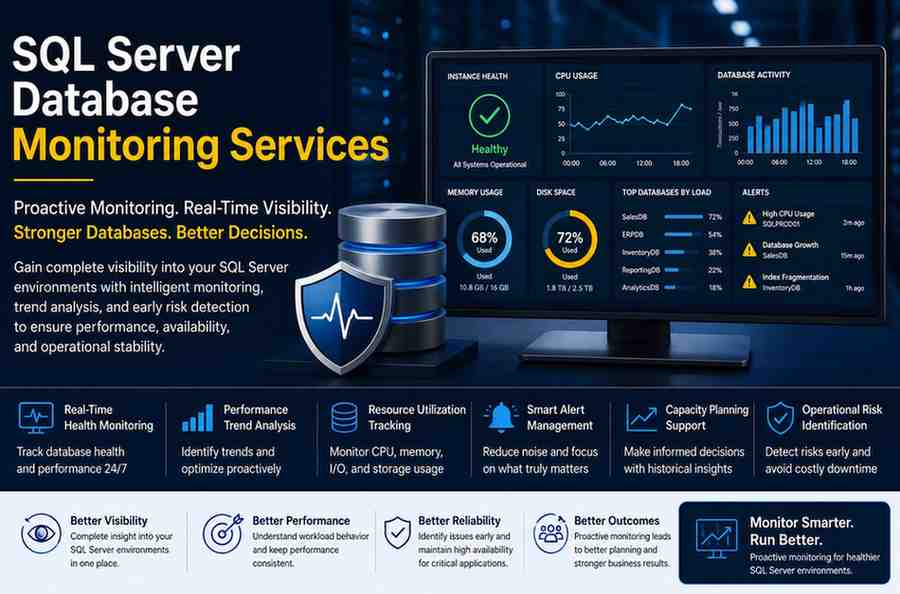
SQL Server Monitoring Services
You Cannot Manage What You Cannot See
Most SQL Server environments do not experience major outages without first providing warning signs.
The problem is not a lack of information.
The problem is visibility.
Every day, SQL Server generates thousands of data points about workload activity, infrastructure utilization, transaction behavior, resource consumption, and application interactions.
Yet many organizations only look at these metrics when something goes wrong.
By that point, valuable opportunities to identify trends and reduce operational risk have already been missed.
At Pinnacle Digitech Edge, our SQL Server Monitoring Services help organizations transform operational data into meaningful visibility that supports informed decision-making, proactive planning, and greater confidence in SQL Server environments.
Rather than focusing exclusively on alerts and notifications, we help businesses understand how their database environment behaves over time and what that behavior may reveal about future operational requirements.
Monitoring Is Not Just About Detecting Problems
Many organizations view monitoring as a defensive activity.
An alert is generated.
A notification is received.
A technical team investigates.
While alerts remain important, modern monitoring delivers significantly greater value.
Monitoring provides context.
It helps organizations understand workload growth patterns, application behavior, infrastructure utilization trends, and long-term changes that may influence future planning decisions.
When monitoring data is interpreted correctly, it becomes a strategic asset rather than a reactive troubleshooting tool.
Why Database Observability Matters
As SQL Server environments become more complex, understanding what is happening inside the database becomes increasingly difficult.
Applications generate more transactions.
Business units consume larger datasets.
Infrastructure evolves.
Cloud adoption accelerates.
New integrations introduce additional dependencies.
These changes create complexity that cannot be managed effectively through manual observation alone.
Database observability provides a broader perspective.
It helps organizations understand relationships between workloads, resource utilization, growth patterns, and operational behavior.
This visibility enables technology teams to identify emerging trends long before they become operational challenges.
Understanding Workload Behavior Over Time
One of the most valuable aspects of SQL Server Monitoring Services is the ability to establish behavioral baselines.
Every SQL Server environment has normal operating patterns.
Transaction activity follows predictable cycles.
Resource consumption fluctuates throughout the day.
Storage utilization grows at measurable rates.
User activity often follows established trends.
When organizations understand these patterns, unusual behavior becomes easier to identify.
More importantly, they gain insight into how workloads evolve as the business grows.
This information supports better planning and more confident decision-making.
The Role Of Trend Analysis In Database Operations
Many organizations focus on what is happening today.
Monitoring provides the opportunity to understand what may happen tomorrow.
Trend analysis helps identify gradual changes that are often invisible during day-to-day operations.
Storage growth may appear manageable in the short term while creating future capacity concerns.
Workload activity may increase steadily without triggering immediate alerts.
Resource consumption may gradually rise as applications expand.
Without historical visibility, these patterns can remain hidden until they create operational pressure.
SQL Server Monitoring Services help organizations uncover these trends and use them to support strategic planning initiatives.
Capacity Forecasting Requires Reliable Data
Infrastructure decisions should be based on evidence rather than assumptions.
Capacity forecasting depends on understanding how database environments are evolving.
Monitoring provides the data required to support these decisions.
Instead of reacting to resource shortages, organizations can anticipate future requirements based on historical growth patterns and operational trends.
This approach improves budgeting accuracy, reduces unexpected infrastructure costs, and supports more effective long-term planning.
Supporting Better Business Decisions
Monitoring is not solely a technical function.
The insights generated by monitoring data often influence broader business decisions.
- Technology investments.
- Infrastructure expansion.
- Application growth strategies.
- Service availability objectives.
- Operational planning.
Reliable monitoring data helps leadership teams make informed decisions with greater confidence.
This connection between technical visibility and business planning is one of the most overlooked benefits of a mature monitoring strategy.
Building A Monitoring Framework That Creates Value
Collecting data is easy.
Creating value from that data is far more challenging.
A successful monitoring framework focuses on relevance rather than volume.
The goal is not to monitor everything.
The goal is to monitor the information that provides meaningful insight into operational health, workload behavior, infrastructure growth, and future planning requirements.
This approach reduces noise while improving visibility into the factors that matter most.
Partner With SQL Server Monitoring Specialists
Organizations that understand their database environments make better decisions.
They identify risks earlier.
They plan infrastructure more effectively.
They gain greater confidence in operational readiness.
Pinnacle Digitech Edge provides SQL Server Monitoring Services that help businesses improve database observability, understand workload behavior, identify long-term trends, and strengthen operational visibility.
Our objective is simple.
Help organizations transform monitoring data into actionable intelligence that supports both technical operations and business growth.
What are SQL Server Monitoring Services?
SQL Server Monitoring Services help organizations gain visibility into workload behavior, resource utilization trends, database activity, and long-term operational patterns.
How are SQL Server Monitoring Services different from SQL Server Production Support Services?
Monitoring focuses on visibility, observability, and trend analysis. Production Support focuses on incident response, escalation management, and operational continuity.
Why is workload visibility important in SQL Server environments?
Workload visibility helps organizations understand database behavior, identify unusual trends, and make informed operational and infrastructure decisions.
Can SQL Server Monitoring Services support capacity forecasting?
Yes. Historical monitoring data provides valuable insights into workload growth, resource consumption, and future infrastructure requirements.
What is database observability?
Database observability refers to the ability to understand how a SQL Server environment behaves through operational metrics, trend analysis, and workload visibility.
Do SQL Server Monitoring Services help identify operational risks?
Yes. Monitoring helps uncover abnormal patterns, resource trends, and workload changes that may indicate emerging operational risks.
What should organizations monitor in SQL Server environments?
Organizations commonly monitor workload activity, infrastructure utilization, storage growth, database behavior patterns, and operational trends.
How does monitoring support long-term planning?
Monitoring provides historical insights that help organizations forecast capacity requirements, evaluate growth patterns, and support strategic planning.
Who benefits from SQL Server Monitoring Services?
Technology teams, database administrators, infrastructure managers, SaaS providers, and enterprises running business-critical SQL Server environments benefit from monitoring services.
Why choose Pinnacle Digitech Edge for SQL Server Monitoring Services?
Pinnacle Digitech Edge helps organizations improve observability, workload visibility, trend analysis, and operational intelligence through structured SQL Server Monitoring Services.