
NBFC Database Query Performance Tuning for Lending and Financial Services Applications
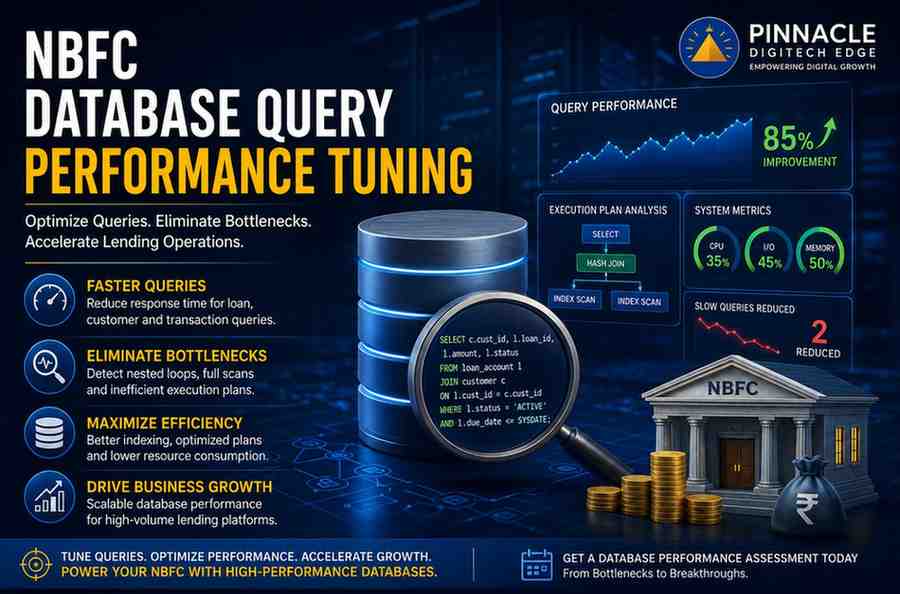
NBFC Database Query Performance Tuning for High-Volume Lending Platforms
When Database Performance Becomes a Business Problem
In the NBFC industry, database performance issues rarely begin as technical concerns. They usually appear first as customer complaints, delayed loan approvals, slow collections processing, failed dashboard reports, or branch teams waiting for applications to load. What starts as a few seconds of delay can quickly impact customer experience, operational efficiency, and revenue generation.
Many growing NBFCs experience performance degradation after years of application growth. New lending products, additional customer data, increased transaction volumes, and integration with multiple financial systems place significant pressure on existing database environments. The result is often production slowdowns that become increasingly difficult to diagnose.
At Pinnacle Digitech Edge, we help financial institutions identify hidden database bottlenecks, optimize query execution paths, and improve system responsiveness across mission-critical lending applications.
The Hidden Cost of Slow Query Execution
A lending platform processes thousands of database transactions every day. Credit assessments, repayment schedules, customer onboarding, compliance reporting, and collection workflows all depend on fast database responses.
As transaction volumes increase, inefficient queries begin consuming excessive CPU, memory, and storage resources. Teams frequently notice that reports which once completed in seconds now require several minutes. Customer service representatives experience application lag during peak business hours. Batch processing windows continue expanding until overnight jobs begin overlapping with business operations.
These symptoms often indicate deeper execution plan inefficiencies that require detailed database investigation rather than additional hardware investments.
Understanding Nested Loop Bottlenecks in Lending Applications
One of the most common performance challenges we encounter in NBFC environments involves poorly performing nested loop joins.
Consider a loan servicing platform where customer accounts are joined with repayment transactions, collection activities, and communication records. As datasets grow into millions of rows, a nested loop execution strategy can force the database engine to repeatedly scan large tables.
Initially, the application performs adequately because data volumes remain manageable. Over time, however, transaction growth dramatically increases execution costs. Queries that previously completed within milliseconds begin consuming several seconds or even minutes.
Database administrators often focus on server resources while overlooking the execution plan itself. The real issue may be that the optimizer is choosing an inefficient access path because of outdated statistics, missing indexes, or suboptimal query design.
A comprehensive execution plan review frequently reveals opportunities to replace expensive nested loops with more efficient join strategies that significantly reduce resource consumption.
Sequential Scans and Why They Create Production Delays
Another recurring issue in NBFC systems is excessive sequential scanning on large transaction tables.
Loan disbursement records, repayment histories, customer profiles, and risk assessment data continuously expand. When commonly searched columns lack proper indexing, the database engine must scan entire tables to locate relevant records.
Imagine a collections team searching delinquent loan accounts every few minutes throughout the day. If the underlying query triggers full table scans, system performance gradually deteriorates as transaction volumes increase.
The impact extends beyond a single user. Multiple concurrent scans create storage bottlenecks, increase I/O latency, and affect every connected application.
Identifying these access path inefficiencies is often one of the fastest ways to restore production performance and improve application responsiveness.
Real-World Query Tuning for Financial Services Workloads
Effective query tuning requires more than simply adding indexes. Every lending platform has unique workload patterns, transaction volumes, reporting requirements, and regulatory obligations.
A successful tuning engagement typically begins with workload analysis. Database specialists evaluate the highest resource-consuming queries, execution frequencies, wait events, and application dependencies.
From there, execution plans are analyzed to determine whether joins, filters, aggregations, or sorting operations are creating bottlenecks. In many cases, query rewrites can dramatically reduce processing requirements without requiring infrastructure upgrades.
For NBFC organizations managing high transaction volumes, targeted tuning initiatives often deliver measurable performance improvements while maintaining application stability.
Optimizing Database Performance for Loan Processing Systems
Loan processing systems generate continuous transactional activity throughout the customer lifecycle. Application performance directly influences customer onboarding speed, underwriting efficiency, collections operations, and portfolio management activities.
Database optimization efforts must therefore focus on both transactional workloads and reporting workloads. A query optimized for reporting may negatively affect transaction throughput if implemented incorrectly.
Balancing these competing requirements requires deep expertise in execution planning, indexing strategy, workload management, and database architecture.
Organizations that proactively optimize their database environments often experience improved application response times, reduced operational delays, and better scalability as lending portfolios expand.
Why Performance Issues Continue Returning
Many organizations resolve performance incidents temporarily by increasing server capacity. While this approach may provide short-term relief, it rarely addresses the root cause.
As data volumes continue growing, inefficient execution plans eventually consume newly available resources. The same production incident returns, often with greater business impact.
Long-term performance stability requires systematic analysis of query design, indexing structures, statistics management, workload patterns, and database architecture.
This approach creates sustainable performance improvements rather than temporary fixes.
How Pinnacle Digitech Edge Helps NBFC Organizations
Pinnacle Digitech Edge specializes in database performance analysis, execution plan optimization, workload assessment, and production database troubleshooting for financial services environments.
Our consultants work closely with technology teams to identify root causes of performance degradation, optimize critical queries, improve database efficiency, and strengthen scalability for future growth.
Whether your organization is experiencing slow loan processing, reporting delays, transaction bottlenecks, or database resource constraints, our specialists can help uncover the underlying causes and implement practical optimization strategies.
Improve NBFC Database Performance Before the Next Production Incident
Database slowdowns rarely resolve themselves. Small inefficiencies accumulate over time until they begin affecting customers, operations, and business growth.
If your lending platform is experiencing query performance issues, execution plan inefficiencies, or database scalability challenges, connect with Pinnacle Digitech Edge for a comprehensive database performance assessment. Our experts can help identify bottlenecks, optimize critical workloads, and improve the reliability of your production database environment before performance issues impact your business operations.
RBI guidelines for NBFC operations NIST cybersecurity framework
Frequently Asked Questions About NBFC Database Query Performance Tuning
What is NBFC Database Query Performance Tuning?
NBFC Database Query Performance Tuning is the process of analyzing and optimizing database queries used by lending platforms, loan management systems, collections applications, customer onboarding systems, and financial reporting environments. The goal is to improve response times, reduce resource consumption, and ensure consistent performance as transaction volumes grow.
Why is NBFC Database Query Performance Tuning important for lending organizations?
As loan portfolios expand, databases process significantly more transactions, customer records, and repayment activities. Without proper NBFC Database Query Performance Tuning, applications can experience slow response times, reporting delays, and operational bottlenecks that directly impact customer experience and business efficiency.
What are the most common causes of database performance issues in NBFC environments?
The most common causes include inefficient SQL statements, missing indexes, excessive sequential scans, poorly optimized joins, outdated database statistics, and rapidly growing transaction tables. A structured NBFC Database Query Performance Tuning assessment helps identify these root causes before they affect production operations.
How can query tuning improve loan management system performance?
Effective query optimization reduces execution times for customer searches, loan approvals, repayment processing, risk calculations, and portfolio reporting. NBFC Database Query Performance Tuning helps ensure critical business processes continue operating efficiently even during peak transaction periods.
Can NBFC Database Query Performance Tuning reduce infrastructure costs?
Yes. Many organizations initially assume performance issues require additional servers or cloud resources. In reality, properly executed NBFC Database Query Performance Tuning often eliminates unnecessary resource consumption, allowing existing infrastructure to support larger workloads more efficiently.
How do nested loop joins affect NBFC application performance?
Nested loop joins can become extremely resource-intensive when large tables are involved. In high-volume lending environments, these execution plans may significantly increase processing time. NBFC Database Query Performance Tuning helps identify and replace inefficient execution strategies with more scalable alternatives.
Why do sequential scans create production slowdowns?
Sequential scans force the database to examine every row within a table. As lending and transaction data grows, these scans can create I/O bottlenecks and application delays. A comprehensive NBFC Database Query Performance Tuning engagement typically identifies opportunities for indexing and execution plan improvements.
How often should NBFC databases be reviewed for performance optimization?
Most financial organizations benefit from quarterly performance reviews. However, rapidly growing lenders may require more frequent assessments. Regular NBFC Database Query Performance Tuning helps prevent performance degradation before it affects customer-facing applications.
Which database platforms benefit from NBFC Database Query Performance Tuning?
The methodology applies to Oracle, PostgreSQL, SQL Server, MySQL, MariaDB, and other enterprise database platforms commonly used within lending and financial services organizations. Performance principles remain similar regardless of the underlying technology.
What business benefits result from database query optimization?
Organizations often experience faster loan processing, improved reporting performance, enhanced customer experience, reduced downtime, lower infrastructure costs, and greater scalability. These outcomes make NBFC Database Query Performance Tuning an important component of technology modernization initiatives.
How long does a typical performance tuning engagement take?
The timeline depends on workload complexity, database size, and the number of critical applications involved. Initial assessments can often identify major bottlenecks within days, while larger NBFC Database Query Performance Tuning projects may continue over several weeks.
Why choose Pinnacle Digitech Edge for NBFC Database Query Performance Tuning?
Pinnacle Digitech Edge combines database engineering expertise with real-world experience supporting business-critical financial workloads. Our consultants focus on identifying root causes, improving execution plans, optimizing database performance, and helping organizations build scalable lending platforms that support long-term growth.