
Optimize SQL Execution Efficiency
PostgreSQL Query Optimization Services
Eliminate Slow Queries and Improve Application Performance
A PostgreSQL database can have powerful hardware, sufficient resources, and a well-designed architecture, yet applications may still suffer from poor performance. In many cases, the root cause is not the database server itself but inefficient SQL statements that consume excessive resources and increase response times.
As applications evolve, queries often become more complex. Additional joins, growing data volumes, missing indexes, outdated execution strategies, and inefficient SQL logic can gradually introduce performance bottlenecks that affect users, reporting systems, and business operations.
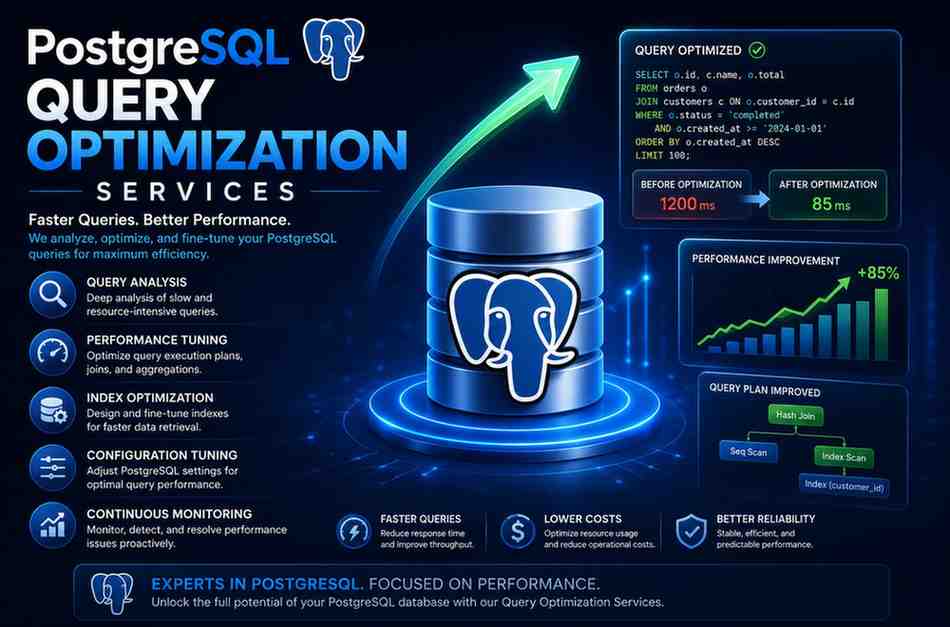
Our PostgreSQL Query Optimization Services focus specifically on improving SQL statement performance. We analyze query execution plans, identify bottlenecks, optimize indexing strategies, and rewrite inefficient SQL statements to reduce execution times and improve application responsiveness.
Whether you are experiencing slow reports, delayed transactions, application latency, or excessive database workload caused by inefficient SQL, our PostgreSQL specialists help identify and resolve query-level performance issues.
What Is PostgreSQL Query Optimization ?
PostgreSQL Query Optimization is the process of improving the performance of SQL statements executed within a PostgreSQL database.
Rather than focusing on database infrastructure or architectural design, query optimization concentrates on how SQL statements access, retrieve, process, and return data.
The objective is to:
- Reduce query execution time
- Minimize resource consumption
- Improve application responsiveness
- Reduce unnecessary database workload
- Improve reporting performance
- Enhance transaction efficiency
Query optimization is often one of the fastest ways to achieve measurable performance improvements without requiring hardware upgrades or major infrastructure changes.
Common Query Performance Problems
Many PostgreSQL performance issues can be traced to a relatively small number of inefficient SQL statements.
Slow Reporting Queries
Business reports often become slower as data volumes increase.
Complex aggregations, multiple joins, and large dataset scans can significantly impact response times.
Excessive Table Scans
Queries that scan large tables unnecessarily consume substantial database resources.
These operations frequently increase execution times and place additional load on production systems.
Inefficient Joins
Poorly structured joins can dramatically increase query costs.
As table sizes grow, inefficient joins may become one of the most significant contributors to application latency.
Missing or Ineffective Indexes
Indexes play a critical role in query performance.
Without proper indexing strategies, PostgreSQL may need to process significantly more data than necessary to return results.
Outdated Query Logic
Applications often contain SQL statements that were originally designed for smaller workloads.
As business requirements evolve, these queries may become inefficient and difficult to scale.
High-Latency Transactions
Transactional systems may experience delays when SQL statements consume excessive processing time.
These delays can affect user experience and business operations.
Our PostgreSQL Query Optimization Methodology
Our consultants follow a structured process to identify and eliminate SQL performance bottlenecks.
Slow Query Analysis
The first step is identifying queries responsible for excessive resource consumption or poor response times.
We analyze:
- Long-running SQL statements
- Frequently executed queries
- High-cost operations
- Resource-intensive transactions
- Reporting workloads
This helps prioritize optimization efforts based on business impact.
Execution Plan Analysis
Execution plans provide critical insight into how PostgreSQL processes SQL statements.
Our specialists review:
- Query execution paths
- Join strategies
- Table access methods
- Sort operations
- Aggregation processing
- Data retrieval patterns
Execution plan analysis often reveals opportunities for substantial performance improvements.
SQL Statement Review
Many performance issues originate from inefficient SQL design.
We evaluate:
- Query structure
- Filtering logic
- Join conditions
- Aggregation methods
- Subquery usage
- Result set processing
The objective is to simplify SQL operations and improve execution efficiency.
Index Optimization Recommendations
Indexing plays a major role in query performance.
Our review includes:
- Existing index effectiveness
- Missing indexes
- Redundant indexes
- Composite index opportunities
- Workload-specific indexing strategies
Proper indexing often delivers significant reductions in query execution times.
Query Rewrite Services
Some SQL statements require redesign rather than incremental adjustments.
Our consultants may recommend:
- SQL rewrites
- Simplified query structures
- Alternative join approaches
- Improved filtering techniques
- More efficient aggregation methods
These improvements help PostgreSQL process workloads more efficiently.
Application Query Review
Database performance challenges often originate within application code.
We work with development teams to evaluate:
- ORM-generated SQL
- Application query patterns
- Reporting workloads
- Batch processing operations
- Transaction-intensive processes
The goal is to align application behavior with database performance objectives.
Benefits of PostgreSQL Query Optimization
Faster Application Response Times
Users experience improved responsiveness and reduced waiting times.
Reduced Database Workload
Efficient SQL statements consume fewer resources and place less strain on database systems.
Improved Reporting Performance
Reports and analytics workloads execute more efficiently and return results faster.
Increased Transaction Throughput
Applications can process more transactions within the same infrastructure environment.
Better User Experience
Performance improvements often have a direct impact on customer satisfaction and productivity.
Lower Infrastructure Costs
Efficient SQL can reduce the need for unnecessary hardware upgrades.
Signs You Need PostgreSQL Query Optimization
Organizations often seek query optimization assistance when they experience:
- Slow reports
- Application latency
- Long-running SQL statements
- High database workload
- Excessive query execution times
- Transaction delays
- Performance issues after application growth
- Increasing operational costs
Addressing inefficient SQL early helps prevent larger performance challenges in the future.
Industries We Support
Our PostgreSQL consultants support organizations across a variety of industries.
Financial Services
Transaction processing systems requiring low-latency SQL performance.
Healthcare
Applications supporting patient data management and reporting.
SaaS Platforms
Multi-user environments requiring efficient application performance.
E-Commerce
Customer-facing systems handling product searches, orders, and inventory operations.
Manufacturing
Operational systems requiring timely reporting and transaction processing.
Technology Companies
Applications supporting large user bases and growing data volumes.
Why Choose Pinnacle Digitech Edge?
Our PostgreSQL specialists combine database administration expertise with practical performance optimization experience.
We focus on:
- Root cause analysis
- SQL performance improvements
- Execution plan expertise
- Indexing strategies
- Application workload optimization
- Measurable business outcomes
Our recommendations are designed to improve performance while minimizing operational disruption.
Related PostgreSQL Services
Performance challenges can originate from different areas of the PostgreSQL environment.
Related services include:
- PostgreSQL Performance Tuning Services
- PostgreSQL Database Optimization Services
- PostgreSQL Production Support Services
- PostgreSQL Architecture Services
- PostgreSQL High Availability Consulting
- PostgreSQL Migration Services
These services complement query optimization initiatives and support long-term PostgreSQL success.
Frequently Asked Questions
What is PostgreSQL Query Optimization?
PostgreSQL Query Optimization focuses on improving SQL statement performance through execution plan analysis, indexing improvements, SQL rewrites, and workload optimization.
How is Query Optimization different from Performance Tuning?
Query Optimization focuses on SQL statements and execution efficiency, while Performance Tuning focuses on server resources, storage performance, memory utilization, and database infrastructure.
Can Query Optimization improve application performance?
Yes. Inefficient SQL statements are often one of the most common causes of application latency and poor user experience.
Do all slow queries require SQL rewrites?
No. Some issues can be resolved through indexing improvements or execution plan optimization. Others may require query redesign.
How quickly can query optimization deliver results?
Many organizations see measurable improvements immediately after implementing optimization recommendations.
Improve PostgreSQL SQL Performance with Expert Query Optimization
Slow SQL statements can significantly affect application responsiveness, user satisfaction, and operational efficiency. Identifying and resolving inefficient queries often delivers faster results than infrastructure upgrades or hardware investments.
Pinnacle Digitech Edge provides PostgreSQL Query Optimization Services focused on improving SQL performance, reducing execution times, and enhancing application responsiveness. Contact our PostgreSQL specialists to discuss your query performance challenges and optimization goals.