
Improve PostgreSQL Database Performance
PostgreSQL performance tuning services
Improve PostgreSQL Database Performance, Stability, and Scalability
PostgreSQL is trusted by organizations worldwide for mission-critical applications, enterprise workloads, SaaS platforms, analytics environments, and high-volume transactional systems. As data volumes increase and workloads become more demanding, PostgreSQL databases can experience performance bottlenecks that impact application responsiveness, user experience, and business operations.
Many organizations assume slow database performance is caused by inefficient SQL queries. In reality, performance issues often originate from deeper infrastructure-level factors such as memory allocation, storage latency, checkpoint activity, autovacuum configuration, connection management, workload distribution, and PostgreSQL server settings.
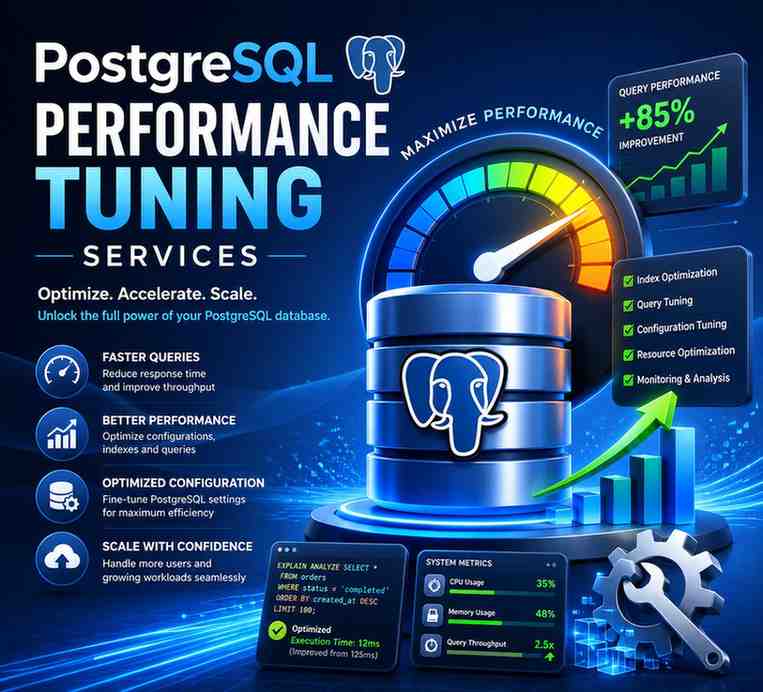
Our PostgreSQL Performance Tuning Services focus on identifying and eliminating system-level bottlenecks that limit database performance. We analyze PostgreSQL configuration parameters, server resources, storage subsystems, workload patterns, and database behavior to improve throughput, reduce resource contention, and support long-term scalability.
Whether you are experiencing slow application response times, increasing database resource consumption, unpredictable performance, or scalability challenges, our PostgreSQL consultants help optimize your database environment for maximum efficiency and reliability.
What Is PostgreSQL Performance Tuning?
PostgreSQL performance tuning is the process of optimizing the database environment to improve overall efficiency, resource utilization, and workload handling capabilities.
Unlike query optimization, which focuses on individual SQL statements, performance tuning examines the broader PostgreSQL ecosystem, including:
- Database server configuration
- Memory management
- CPU utilization
- Storage performance
- WAL management
- Checkpoint behavior
- Vacuum operations
- Autovacuum settings
- Connection handling
- Workload balancing
- Resource contention
The objective is to create a PostgreSQL environment capable of supporting current and future business demands while maintaining predictable performance and operational stability.
Common PostgreSQL Performance Challenges
Many organizations encounter performance issues as database workloads grow.
Slow Application Response Times
Applications may become slower even when no major changes have been introduced. Increasing data volumes and growing transaction rates can gradually impact overall performance.
Excessive Disk I/O
Poor storage performance often becomes a major bottleneck, especially in environments processing large transactional workloads.
High CPU Utilization
CPU saturation can occur due to inefficient workload distribution, background processes, and resource-intensive operations.
Memory Pressure
Improper memory allocation may lead to excessive disk reads, reduced cache efficiency, and increased response times.
Checkpoint Overhead
Frequent checkpoint activity can generate significant I/O spikes and negatively affect transactional performance.
Autovacuum Inefficiencies
Autovacuum plays a critical role in maintaining PostgreSQL performance. Poorly configured vacuum processes can contribute to table bloat and resource contention.
Connection Saturation
Large numbers of concurrent connections may increase resource consumption and reduce database responsiveness.
Scalability Limitations
As workloads grow, database infrastructure may struggle to support increasing transaction volumes and user activity.
Our PostgreSQL Performance Tuning Approach
Our consultants follow a structured methodology designed to identify the root causes of performance degradation.
Performance Assessment
The engagement begins with a comprehensive analysis of the PostgreSQL environment.
Areas reviewed include:
- PostgreSQL configuration
- System resource utilization
- Workload characteristics
- Storage performance
- Operating system metrics
- Background process activity
- Database growth trends
The objective is to establish a baseline for performance evaluation.
PostgreSQL Configuration Review
Many performance issues originate from default or outdated PostgreSQL configuration settings.
We evaluate parameters including:
- shared_buffers
- work_mem
- maintenance_work_mem
- effective_cache_size
- wal_buffers
- max_connections
- checkpoint settings
- autovacuum parameters
Configuration settings are aligned with workload requirements and infrastructure capabilities.
Memory Optimization
Memory management significantly influences PostgreSQL performance.
Our review focuses on:
- Buffer cache efficiency
- Memory allocation strategies
- Temporary memory usage
- Sorting operations
- Hash operations
- Shared memory utilization
Optimized memory settings improve throughput while reducing unnecessary disk activity.
Storage Performance Analysis
Storage subsystems often represent one of the most significant performance constraints.
We evaluate:
- Disk latency
- IOPS capacity
- Read and write performance
- WAL storage configuration
- Storage architecture
- File system efficiency
The goal is to eliminate storage bottlenecks and improve transaction processing efficiency.
Checkpoint Optimization
Checkpoint operations are necessary for database consistency but can create performance challenges when not properly configured.
Our specialists review:
- Checkpoint frequency
- Checkpoint duration
- Write patterns
- WAL generation rates
- Recovery objectives
Proper checkpoint tuning helps reduce I/O spikes and improve workload stability.
WAL Performance Tuning
Write-Ahead Logging is a core PostgreSQL component that directly affects transaction processing performance.
Our review includes:
- WAL generation patterns
- WAL buffer allocation
- Archiving performance
- Replication impact
- Transaction throughput
Optimizing WAL operations contributes to better write performance and improved database reliability.
Autovacuum Optimization
Autovacuum is essential for maintaining PostgreSQL performance over time.
We assess:
- Autovacuum thresholds
- Vacuum frequency
- Table bloat indicators
- Dead tuple accumulation
- Maintenance workload impact
Effective vacuum management prevents long-term performance degradation.
Connection Management Review
Excessive database connections can negatively impact overall performance.
Our consultants evaluate:
- Connection patterns
- Connection pooling opportunities
- Session utilization
- Resource consumption
- Concurrent workload behavior
Optimized connection management improves scalability and resource efficiency.
Benefits of PostgreSQL Performance Tuning
Organizations that invest in performance tuning typically experience measurable operational improvements.
Faster Database Operations
Improved resource utilization enables PostgreSQL to process workloads more efficiently.
Improved Application Performance
Users benefit from faster response times and a more consistent application experience.
Better Resource Efficiency
Optimized environments reduce unnecessary CPU, memory, and storage consumption.
Increased Scalability
Well-tuned PostgreSQL environments are better prepared for future workload growth.
Reduced Infrastructure Costs
Efficient databases often require fewer hardware resources to support the same workload.
Greater Operational Stability
Performance tuning reduces the likelihood of unexpected slowdowns and resource bottlenecks.
When Should You Consider PostgreSQL Performance Tuning?
Organizations often engage performance specialists when experiencing:
- Growing database workloads
- Application slowdowns
- Resource utilization spikes
- Storage bottlenecks
- Increasing transaction volumes
- Scalability concerns
- Infrastructure modernization initiatives
- Cloud migration projects
Proactive tuning is generally more cost-effective than reacting to production performance incidents.
Industries We Support
Our PostgreSQL consultants support organizations across a wide range of industries.
Financial Services
High-volume transaction processing and reporting systems.
Healthcare
Critical healthcare applications requiring consistent database performance.
SaaS Platforms
Multi-tenant environments with demanding scalability requirements.
E-Commerce
Databases supporting large product catalogs and transactional workloads.
Manufacturing
Operational systems processing production and supply chain data.
Technology Companies
Applications requiring high availability and predictable performance.
Why Choose Pinnacle Digitech Edge?
Our team combines database administration expertise, performance engineering experience, and production support knowledge to deliver practical optimization solutions.
We focus on:
- Root cause analysis
- Measurable performance improvements
- Infrastructure efficiency
- Scalability planning
- Long-term database stability
- Production-ready recommendations
Every engagement is tailored to the specific workload characteristics and business objectives of the organization.
Related PostgreSQL Services
If your performance challenges originate from other areas of the PostgreSQL environment, you may also benefit from:
- PostgreSQL Database Optimization Services
- PostgreSQL Query Optimization Services
- PostgreSQL Architecture Services
- PostgreSQL Production Support Services
- PostgreSQL Migration Services
Our consultants can help determine the most appropriate optimization strategy based on your environment and business requirements.
Frequently Asked Questions
What is PostgreSQL Performance Tuning?
PostgreSQL Performance Tuning is the process of improving database efficiency through configuration optimization, resource management, storage analysis, and infrastructure-level performance improvements.
How is Performance Tuning different from Query Optimization?
Performance tuning focuses on the overall PostgreSQL environment, including memory, storage, checkpoint activity, and resource utilization. Query optimization focuses specifically on improving SQL statement performance.
How long does a PostgreSQL Performance Assessment take?
The duration depends on database size, workload complexity, and infrastructure architecture. Most assessments can be completed within a few days.
Can performance tuning reduce infrastructure costs?
Yes. Optimizing resource utilization often enables organizations to achieve better performance without increasing hardware investment.
Do you support cloud-hosted PostgreSQL environments?
Yes. We support PostgreSQL deployments hosted on cloud platforms, hybrid environments, and on-premises infrastructure.
Improve PostgreSQL Performance with Expert Guidance
Database performance problems rarely resolve themselves. As workloads grow, even small inefficiencies can become significant operational challenges.
Pinnacle Digitech Edge provides PostgreSQL Performance Tuning Services designed to improve efficiency, scalability, and long-term database stability. Contact our specialists to discuss your PostgreSQL environment and discover opportunities for performance improvement.