
Resolve PostgreSQL Performance Bottlenecks Before They Impact Users
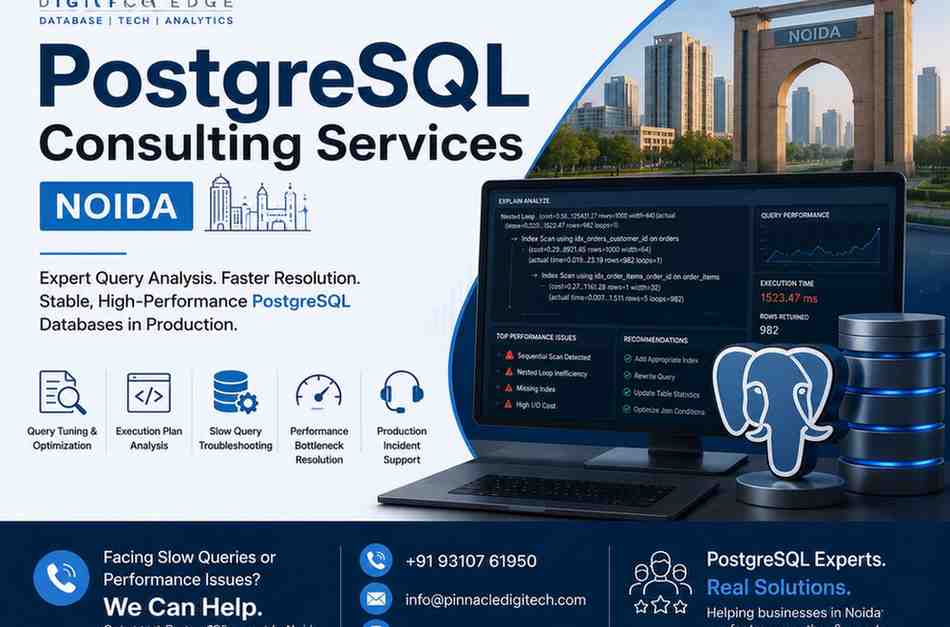
PostgreSQL Consulting Services in Noida
When PostgreSQL Suddenly Slows Down, The Problem Is Usually Not What It Seems
Most production incidents begin with a message that appears harmless.
A customer reports that a dashboard is taking longer than usual to load. An internal reporting process misses its expected completion window. A support ticket mentions intermittent delays during peak business hours.
At first, nobody suspects a database issue.
Application servers appear healthy. Infrastructure monitoring shows sufficient resources. Network latency remains within normal ranges.
Yet something is clearly wrong.
As engineering teams begin investigating, they discover a familiar pattern. A query that previously completed in milliseconds now takes several seconds. A batch process starts consuming significantly more resources. Database sessions accumulate faster than expected. User complaints increase while technical teams struggle to identify the root cause.
These situations are common in growing PostgreSQL environments.
What makes them challenging is that the visible symptom rarely reveals the actual problem.
At Pinnacle Digitech Edge, our PostgreSQL Consulting Services in Noida focus on identifying and resolving production database bottlenecks that disrupt application performance, delay critical business processes, and create operational uncertainty.
Rather than concentrating exclusively on infrastructure upgrades or generic database administration, we help organizations investigate the specific query execution behaviors that frequently trigger production slowdowns.
The Execution Plan Usually Tells The Real Story
Many organizations begin troubleshooting with resource metrics.
CPU usage becomes the first suspect.
Memory utilization receives immediate attention.
Storage performance is examined next.
While these indicators provide useful information, they often fail to explain why a particular workload suddenly became inefficient.
The real answers are frequently hidden inside query execution plans.
A PostgreSQL execution plan provides a detailed view of how the optimizer chooses to access data, process joins, estimate row counts, and return results.
When application performance deteriorates unexpectedly, the execution plan often reveals a series of decisions that no longer align with current data distribution or workload characteristics.
This is where experienced PostgreSQL consultants can dramatically reduce troubleshooting time.
Instead of treating symptoms, we focus on understanding why the optimizer selected a particular execution path and whether that decision still makes sense for the current workload.
Understanding Why Sequential Scans Become Expensive
One of the most common production issues involves unexpected sequential scans.
At smaller data volumes, sequential scans may perform adequately.
A table containing a few thousand records can often be scanned quickly without creating noticeable delays.
The situation changes when business growth introduces millions of rows.
A query that previously completed instantly may suddenly require significantly more resources simply because PostgreSQL is reading the entire table instead of locating the required records efficiently.
Development teams are often surprised when a query that has remained unchanged for months suddenly becomes problematic.
The query itself may not be the issue.
The underlying table growth may have reached a point where the optimizer’s chosen access path is no longer efficient.
Investigating these situations requires more than adding indexes blindly.
Effective analysis examines workload patterns, filter conditions, data selectivity, index design, and optimizer statistics before recommending corrective action.
Why Nested Loop Joins Can Create Hidden Bottlenecks
Nested loop joins represent another frequent source of production performance incidents.
Under the right conditions, nested loops can be extremely efficient.
When processing small result sets, they often outperform alternative join strategies.
Problems emerge when PostgreSQL significantly underestimates the number of rows involved in a query.
A nested loop that appears efficient on paper may execute millions of internal operations once the query runs against real production data.
The result is often dramatic.
Response times increase unexpectedly.
Application requests begin timing out.
Batch jobs consume far more resources than anticipated.
Teams frequently discover that a query performing well in testing behaves very differently in production.
The difference is usually not the query syntax.
The difference is data volume, distribution patterns, and optimizer assumptions.
Understanding these factors requires careful execution plan analysis combined with practical production experience.
PostgreSQL Query Problems Rarely Exist In Isolation
A slow query is often the visible symptom of a larger workload issue.
For example, an inefficient reporting process may generate excessive I/O activity that impacts unrelated transactional workloads.
A poorly designed join strategy may increase lock durations across multiple application components.
An expensive aggregation process can consume resources that affect user-facing transactions throughout the environment.
This interconnected behavior is why effective PostgreSQL consulting requires examining the broader workload rather than focusing exclusively on individual queries.
We evaluate query execution characteristics, workload concurrency, locking behavior, statistics accuracy, indexing effectiveness, data growth patterns, and application access methods.
This broader perspective helps organizations identify root causes that would otherwise remain hidden beneath secondary symptoms.
Real-World Query Tuning Requires Context
Many online optimization guides present PostgreSQL tuning as a collection of universal rules.
Reality is rarely that simple.
A recommendation that improves one workload may negatively affect another.
An index that accelerates reporting activity may introduce unnecessary overhead for write-intensive operations.
A query rewrite that appears efficient in development may perform differently under production concurrency.
For this reason, successful query tuning requires context.
Understanding how data is accessed, how applications behave, how workloads evolve throughout the day, and how future growth may affect execution patterns is often more valuable than applying generic optimization techniques.
This practical approach enables engineering teams to implement changes with confidence rather than relying on trial-and-error experimentation.
Why Organizations Engage PostgreSQL Consultants During Production Incidents
Production incidents create pressure.
Business stakeholders need answers quickly.
Engineering teams require accurate diagnosis.
Management needs confidence that corrective actions will prevent recurrence.
An independent PostgreSQL consulting engagement can provide the expertise required to accelerate investigation efforts and reduce operational risk.
Instead of spending days reviewing thousands of lines of application code or making speculative infrastructure changes, organizations gain focused analysis based on PostgreSQL internals, execution behavior, and workload characteristics.
The result is often faster resolution, improved system stability, and a clearer understanding of the factors contributing to performance degradation.
PostgreSQL Consulting for Manufacturing, E-Commerce, and Logistics Businesses in Noida
Noida is a major center for manufacturing, e-commerce, logistics, media, and technology-driven business operations. Organizations in these sectors often manage large volumes of operational data that require reliable, scalable, and cost-effective database platforms.
Our PostgreSQL Consulting Services Noida help businesses optimize database environments to support operational efficiency, reporting requirements, and long-term growth.
Supporting Manufacturing Operations
Manufacturing organizations rely on accurate and timely information to manage production planning, inventory control, procurement activities, and quality management processes.
PostgreSQL can support:
- ERP platforms
- Inventory management systems
- Production monitoring applications
- Supply chain reporting
- Operational analytics
- Business intelligence initiatives
Strategic consulting ensures that database environments align with business objectives and operational requirements.
PostgreSQL for E-Commerce Platforms
E-commerce businesses require database platforms capable of handling fluctuating traffic patterns, high transaction volumes, and real-time customer interactions.
Our consultants help organizations address:
- Performance optimization
- Scalability planning
- Database architecture reviews
- Reporting improvements
- Availability requirements
- Operational resilience
These initiatives help businesses maintain a positive customer experience while supporting growth.
Data-Driven Decision Making
Organizations increasingly rely on data analytics to improve operational visibility and support strategic decision-making.
PostgreSQL environments can support:
- Reporting systems
- Dashboard platforms
- Business intelligence tools
- Data integration initiatives
- Performance analysis
- Forecasting models
Our PostgreSQL Consulting Services Noida help businesses create database strategies that support both operational efficiency and future growth.
Get Expert PostgreSQL Investigation And Resolution Support
If your team is dealing with slow queries, unexplained database latency, execution plan anomalies, inefficient join strategies, or production performance incidents, the underlying cause may be deeper than resource utilization metrics suggest.
Pinnacle Digitech Edge provides PostgreSQL consulting services for organizations that need practical expertise, detailed execution plan analysis, and real-world troubleshooting support for business-critical environments.
Connect with our PostgreSQL specialists to investigate performance bottlenecks, identify root causes, and restore confidence in your production database environment.
Frequently Asked Questions (FAQs)
1. What are PostgreSQL Consulting Services in Noida?
PostgreSQL Consulting Services in Noida help businesses design, optimize, secure, and manage PostgreSQL database environments. These services include database architecture, performance tuning, migration, troubleshooting, and ongoing support.
2. Why should businesses choose PostgreSQL Consulting Services in Noida?
Businesses choose PostgreSQL Consulting Services in Noida to improve database performance, scalability, reliability, and security with expert guidance from experienced database consultants.
3. Do you provide PostgreSQL database performance tuning in Noida?
Yes, our PostgreSQL experts analyze slow queries, indexing issues, database configuration, and workload patterns to improve PostgreSQL application performance.
4. Can you help with PostgreSQL database migration?
Yes, we support PostgreSQL migration projects including planning, data transfer, testing, optimization, and post-migration performance monitoring.
5. What industries need PostgreSQL Consulting Services in Noida?
PostgreSQL Consulting Services in Noida are useful for industries such as banking, lending, real estate, healthcare, SaaS, eCommerce, manufacturing, and enterprise applications.
6. Do you provide PostgreSQL database administration support?
Yes, we provide PostgreSQL administration services including monitoring, backup management, security configuration, troubleshooting, and database maintenance.
7. Can PostgreSQL consultants improve my existing database architecture?
Yes, our consultants review your current database design and recommend improvements for scalability, availability, performance, and future growth.
8. Do you provide high availability solutions for PostgreSQL?
Yes, our PostgreSQL Consulting Services in Noida include high availability planning, replication setup, failover strategies, and database reliability improvements.
9. Can you optimize PostgreSQL queries and indexes?
Yes, we optimize SQL queries, execution plans, indexes, and database parameters to reduce response time and improve application performance.
10. Do startups need PostgreSQL consulting support?
Yes, startups benefit from PostgreSQL Consulting Services in Noida by building scalable database foundations, avoiding performance issues, and reducing future infrastructure costs.
11. Do you provide remote PostgreSQL support for Noida companies?
Yes, we provide remote PostgreSQL consulting and support for businesses requiring database monitoring, optimization, and technical assistance.
12. How can PostgreSQL consulting improve business applications?
PostgreSQL Consulting Services in Noida help applications run faster by improving database design, query performance, reliability, and data management practices.
13. Do you provide PostgreSQL security assessment?
Yes, we help businesses improve PostgreSQL security through access control reviews, configuration optimization, auditing, and best practices implementation.
14. How experienced are your PostgreSQL consultants?
Our database consultants have extensive experience working with enterprise databases, production environments, performance optimization, and mission-critical applications.
15. How can I get started with PostgreSQL Consulting Services in Noida?
You can contact Pinnacle Digitech Edge for a PostgreSQL assessment. Our team will review your database requirements and suggest the right optimization or consulting approach.
16.Can PostgreSQL support manufacturing systems?
Yes. PostgreSQL is widely used to support ERP, inventory management, production planning, and operational reporting applications.
17.Is PostgreSQL suitable for e-commerce platforms?
Yes. PostgreSQL can handle transactional workloads, customer-facing applications, and reporting requirements commonly found in e-commerce environments.
18.Can PostgreSQL integrate with business applications?
Yes. PostgreSQL supports integration with a wide range of enterprise applications, analytics platforms, and operational systems.
Our Related PostgreSQL Services
Performance challenges can originate from different areas of the PostgreSQL environment.
Related services include:
- PostgreSQL Database Optimization Services
- PostgreSQL Production Support Services
- PostgreSQL High Availability Consulting
- PostgreSQL Migration Services
- PostgreSQL Performance Tuning Services
- PostgreSQL Architecture Services
These services complement query optimization initiatives and sup port long-term PostgreSQL success.
For postgress database please visit